
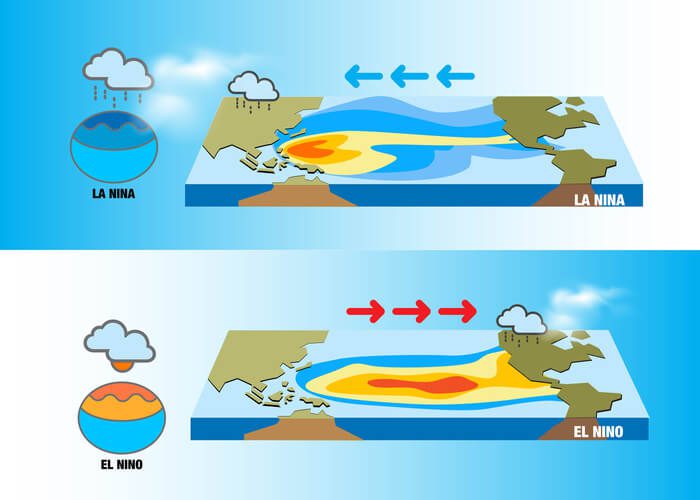
A naturally occurring climate phenomenon marked by the warming of sea surface temperatures in the central and eastern tropical Pacific Ocean, which disrupts global weather patterns, often bringing floods, droughts, and shifts in storm activity. It’s part of the larger El Niño–Southern Oscillation (ENSO) cycle, which alternates between El Niño (warm phase), La Niña (cool phase), and neutral conditions mostly being average.
Main Causes: –
Trade Winds Weakening: Normally, strong easterly trade winds push warm water westward toward Asia. During El Niño, these winds weaken or reverse, allowing warm water to spread eastward.
Ocean–Atmosphere Feedback: The shift in warm water alters convection (rising warm air), changing rainfall and storm patterns globally.
Global Impact: –
- South America (Peru, Ecuador): Heavy rainfall and flooding.
- South Asia (India, Sri Lanka): Often linked to weaker monsoons and drought risk.
- Australia & Indonesia: Severe droughts and higher wildfire risk.
- North America: Wetter winters in the southern U.S., warmer winters in the north.
Marine Life: –
Warmer waters reduce nutrients, leading to fish stock collapses (e.g., anchovy fisheries off Peru).
Key Features of El Nino: –

Can Sri Lanka be impacted by an El Nino Wave? Or has it!?
Sri Lanka has a history of being affected by El Niño events, with notable impacts on rainfall, agriculture, and water resources. The 2015–2016 El Niño was particularly significant, bringing drought conditions and stressing food security, while earlier events have also disrupted monsoons and seasonal rainfall patterns.
Bygone Events: –
1997–1998 El Niño:
- One of the strongest global El Niño events.
- In Sri Lanka, it disrupted monsoon rainfall, leading to dry spells in some regions and floods in others.
2014–2016 El Niño (extended influence):
- Documented impacts on water resources, agriculture, disaster risk, and health.
- Effects varied by region and season due to the Indian Ocean’s influence on local climate.
2015–2016 El Niño:
- Brought severe drought conditions across much of Sri Lanka.
- Reduced water availability for agriculture and hydropower.
- Increased risk of food insecurity and economic stress.
Expecting An El Nino soon?
Sri Lanka is expected to face El Niño conditions by May 2026, with climatologists warning of a possible dry spell and severe heat that could weaken the Southwest Monsoon. However, meteorologists also note that current scorching temperatures are not yet directly linked to El Niño, and showers may still occur in mid-April.
Forecast Breakdown: –
- Timing: El Niño conditions are projected to develop by early May 2026.
- Heat & Dry Spell: Experts caution that El Niño could bring severe heat and reduced rainfall, particularly affecting the Southwest Monsoon (May–September).
- April Showers: Despite the looming El Niño, rainfall is expected in mid-April, offering temporary relief.
- Energy Concerns: The government has already launched the “Surakimu Lanka” energy conservation program to prepare for possible supply disruptions linked to El Niño and other global risks.
What will this mean for SL: –
- Agriculture: Paddy cultivation and tea plantations could face water stress if monsoon rains weaken.
- Water Resources: Reservoir levels may drop, affecting hydropower generation and drinking water supply.
- Health Risks: Prolonged heat waves increase the risk of heat-related illnesses and waterborne diseases during any floods.
- Economy: Energy conservation measures highlight concerns about electricity demand management during potential droughts.
Conclusion
El Niño is more than a distant Pacific Ocean phenomenon it is a global climate driver with direct consequences for Sri Lanka. From weakened monsoons and droughts to occasional floods, its impacts ripple across agriculture, water resources, and public health. With forecasts pointing to El Niño conditions in 2026 that may extend into 2027, Sri Lanka faces a critical period requiring vigilance, adaptation, and proactive planning. By understanding the ENSO cycle and preparing for its challenges, the country can better safeguard livelihoods and build resilience against future climate shocks.
Owned Sources :-
https://www.dailymirror.lk/breaking-news/Sri-Lanka-braces-for-EL-Nino-impact-by-May/108-336472
https://news.mongabay.com/2026/03/sri-lanka-sweats-in-scorching-heat-but-reasons-unlikely-due-to-el-
https://www.severe-weather.eu/long-range-2/el-nino-watch-2026-seasonal-weather-impacts-united-stat
https://www.ft.lk/columns/Sri-Lanka-s-rising-heat-Is-El-Ni%C3%B1o-the-real-cause/4-790439





Leave a Reply